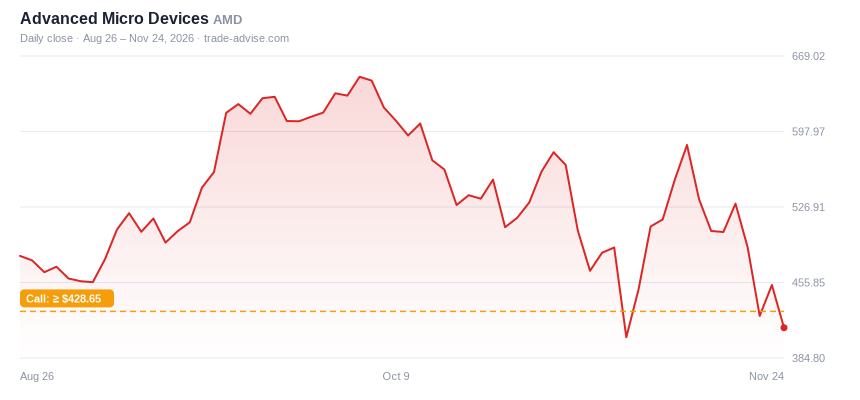
Three of the ten largest names on the board closed at the exact floor of their 90-day ranges on Tuesday: Advanced Micro Devices (AMD) at $396.85, Alphabet (GOOGL) at $277.07, and JPMorgan Chase (JPM) at $314.68. That happened on a session when Asian equities staged one of the sharpest AI-led rallies of the year, with South Korea's KOSPI up 7.5%, Taiwan up 9.1%, and the Nikkei up 5% on renewed confidence in the semiconductor complex. US cash declined to ratify any of it. The implication is that what is being repriced here is broader than a chip-cycle story, and the overnight enthusiasm did not survive contact with domestic order flow.

The Data Point
AMD lost $56.61 per share, a 12.48% decline, and the anatomy of that loss matters more than the headline percentage. The stock gapped down $27.94 at the open to $425.52, then surrendered an additional $28.67 during regular hours to finish at $396.85 — within 75 cents of the session low of $396.10. The split is almost exactly even between imported weakness and domestic selling, which distinguishes this from a pure overnight-sentiment transfer. A gap that holds is a repricing event; a gap that extends through the full session is a supply condition, and Tuesday was the second kind.
| Symbol | Close | Change | Day range | 52-week range |
|---|---|---|---|---|
| AAPL | $354.07 | +4.99 (+1.43%) | $345.88–$354.40 | $243.42–$360.83 |
| MSFT | $496.13 | +3.63 (+0.74%) | $488.43–$501.82 | $349.20–$559.15 |
| NVDA | $155.38 | -9.67 (-5.86%) | $150.50–$159.92 | $124.50–$243.37 |
| GOOGL | $279.05 | -3.05 (-1.08%) | $276.03–$281.78 | $264.22–$408.61 |
| AMZN | $252.29 | -3.10 (-1.21%) | $250.53–$255.56 | $196.00–$287.20 |
| META | $589.82 | -7.78 (-1.30%) | $584.26–$600.32 | $520.26–$779.82 |
| TSLA | $384.68 | -0.78 (-0.20%) | $375.50–$390.09 | $297.38–$498.83 |
| JPM | $317.10 | +0.44 (+0.14%) | $313.62–$319.01 | $279.10–$366.50 |
| V | $416.78 | +7.38 (+1.80%) | $407.40–$416.87 | $293.89–$442.23 |
| AMD | $413.27 | -40.19 (-8.86%) | $396.01–$428.87 | $188.22–$658.52 |
The valuation consequence is concrete. At the close, AMD sits 39.7% below its 90-day high of $657.93 and 39.7% below its 52-week high of $658.52. Over five sessions the stock is down 19.8%, which is roughly $97.98 per share of value removed in a single trading week — more than half the distance back to its 52-week low of $188.22 would require, erased in five days. This confirms the call for a break of the $424.36 level made on Nov. 20. It also underscores how wrong the earlier case for a reclaim of $566.57 was — that level is now 42.8% above the close, and the de-rating has been continuous rather than corrective.
The Numbers
NVIDIA (NVDA) fell 8.11% to $151.66, giving back a substantial portion of Monday's leadership-driven surge. The stock gapped down $5.98 and then lost a further $7.41 intraday, closing in the lower tenth of its $150.80–$159.89 range. Over thirty sessions NVIDIA is down 32.5%, which translates to approximately $73 per share of market value shed per share outstanding in six weeks. It remains 10.6% above its 90-day low of $137.18 — the one meaningful cushion in the AI complex that has not yet been tested.

The relative-performance spread is where the session's character shows. Microsoft (MSFT) closed up 0.55% at $495.21, Apple (AAPL) up 0.51% at $350.86, and Visa (V) up 1.12% at $414.00 — three green closes against seven red. The gap between AMD and Microsoft on the day is 13.03 percentage points. However, Microsoft's green close is less reassuring than it reads: at $495.21 it sits just 0.7% above its own 90-day low of $491.76, and it is down 9.5% over thirty sessions. Apple is the genuine relative-strength name, 2.0% below its 90-day high after two consecutive green closes.
Three names closed at the exact bottom of their three-month ranges on Tuesday, and only one of them is a semiconductor company.
On Visa, a prior call for a move above $432.48 has not worked. Three straight green closes have recovered some ground, but the stock remains 4.3% below that level, and the pace of the recovery has been too slow to justify the original timeframe.
The Counterargument
The constructive case has real support. Asian markets validated the AI leadership story overnight with moves large enough to qualify as a regime signal rather than noise, and commentary from CNBC's Investing Club argued explicitly for deploying sidelined cash into oversold conditions. Retail earnings reported Tuesday pointed to a resilient consumer and improved execution heading into the holiday season, which is a genuine fundamental input rather than a sentiment read. If the AI de-rating is a multiple compression rather than an earnings event, then prices this far below recent highs are compensating buyers for risk.

The problem is that the price structure does not corroborate it. A durable low in a de-rating typically shows closes well off the session low, and both AMD and NVIDIA finished in the lower tenth of their ranges. Alphabet's close at its 90-day low — down 22.2% over thirty sessions — and JPMorgan's close at its own three-month floor indicate the selling has moved beyond the chipmakers into the index's largest non-AI weights. That breadth is the argument against treating Monday's rally as the turn.
Verdict
Stretched. Not the valuations — the rebound case. AMD at $396.85 would need to add $31.80 per share, or 8.0%, merely to reclaim Tuesday's session high of $428.65, and a close above that level within five sessions would overturn this read entirely by framing Tuesday as a liquidation flush rather than trend continuation. Below it, the more probable path tests NVIDIA's 90-day low of $137.18, which is 9.5% beneath Tuesday's close and the next structural reference in the complex. What would change the view is a session in which the AI names close in the upper third of their ranges while Alphabet and JPMorgan hold above their new lows — that combination would mark genuine absorption. Until it appears, buying strength in this group is paying for a bottom the price action has not yet produced.