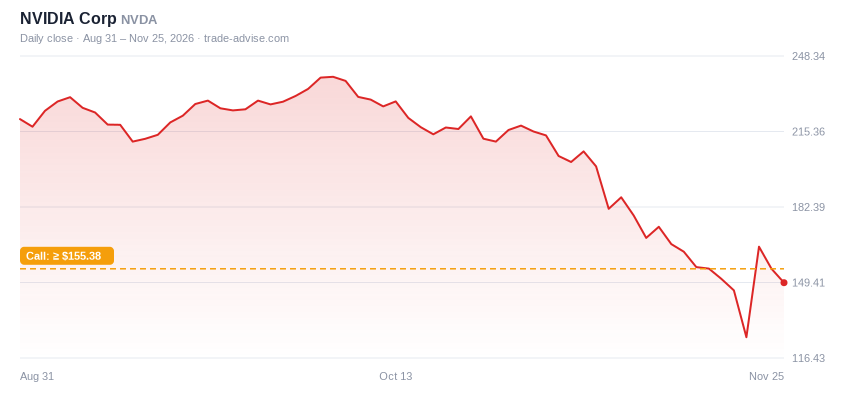
NVIDIA closed Wednesday's session at $149.30, which leaves the stock at 15.9x trailing earnings against a 23.1x median for the ten large-cap names we track. The reinstatement of Jensen Huang on Monday settled who runs the company, but a multiple roughly 31% below that median says investors are still pricing governance risk rather than earnings risk. The distinction matters, because a governance discount tends to narrow once the process around it becomes predictable, while an earnings discount requires the numbers themselves to change.

The news since Monday has been about process. Huang returned to the company, apologized to the entire workforce, said he is in therapy and stated that Nvidia's board brought him back after it gathered facts. The Washington Post reported that administration officials, including Defense Secretary Pete Hegseth, considered using a 1950 wartime law to pressure the board into reinstating him, and Huang is due before the House Foreign Affairs Committee next week. S&P is reportedly weighing a downgrade of Nvidia's AA credit rating over the board's reversal, while Moody's said the reinstatement restores strategic continuity but leaves governance issues unresolved.
Wednesday's session showed how that uncertainty is being priced. The stock opened at $144.06, a 7.29% gap below Tuesday's $155.38 close, touched $141.17 and then recovered to finish at 88% of the day's range for a 3.91% loss. CNBC described the decline as the Huang comeback rally fizzling as AI spending and rate concerns returned, and volume of 363.4 million shares ran at 1.1 times the 20-session average. The recovery off the low is a single-session observation, however, and the stock still sits 26.7% below its 50-session average of $203.65.
The Setup
The cleanest comparison is AMD, the nearest competitor in accelerated computing. NVDA trades at 15.9x trailing earnings of $9.31 per share, whereas AMD, which closed Wednesday at $406.03, trades at 87.4x trailing earnings of $4.60. On free cash flow the spread is similar: NVIDIA's 24.2x price-to-free-cash-flow multiple equates to a yield of about 4.1%, while AMD's 94.4x leaves roughly 1.1%. In plain terms, a dollar invested in NVIDIA buys about five and a half times the current earnings of a dollar invested in AMD.
| Symbol | Close | Change | Day range | 52-week range |
|---|---|---|---|---|
| AMD | $406.03 | -7.24 (-1.75%) | $370.40–$407.77 | $188.22–$658.52 |
| V | $424.39 | +7.61 (+1.83%) | $413.47–$426.67 | $293.89–$442.23 |
| JPM | $316.74 | -0.36 (-0.11%) | $309.49–$318.41 | $279.10–$366.50 |
| TSLA | $380.14 | -4.54 (-1.18%) | $357.64–$383.73 | $297.38–$498.83 |
| META | $609.89 | +20.07 (+3.40%) | $567.75–$611.06 | $520.26–$779.82 |
| AMZN | $244.43 | -7.86 (-3.12%) | $235.96–$246.56 | $196.00–$287.20 |
| GOOGL | $273.10 | -5.95 (-2.13%) | $262.73–$273.62 | $262.76–$408.61 |
| NVDA | $149.30 | -6.08 (-3.91%) | $141.17–$150.37 | $124.50–$243.37 |
| MSFT | $489.93 | -6.20 (-1.25%) | $477.39–$493.44 | $349.20–$559.15 |
| AAPL | $355.58 | +1.51 (+0.43%) | $345.13–$356.75 | $243.42–$360.83 |
At the 23.1x peer median, NVIDIA's $9.31 of trailing EPS would support roughly $215 per share, about 44% above Wednesday's close.
Why the Gap Exists
On the reported fundamentals, the gap runs the wrong way. NVIDIA grew revenue 93.3% year on year against 41.9% at AMD, and its 65.5% operating margin is more than three times AMD's 17.7%. Gross margin tells the same story at 74.9% versus 53.7%, and both companies beat their last quarterly EPS estimates by 6.1%. A multiple premium for AMD therefore has to rest on the margin trajectory rather than the current print, meaning the expectation that operating leverage from a low base lifts earnings faster than revenue.

That expectation is under pressure as well. AMD has fallen 23.4% over five sessions and closed just 0.4% above its 90-day low of $404.40, even after recovering from a Wednesday low of $370.40. The implication is that the market is compressing the AMD premium and the NVIDIA discount at the same time, though from very different starting points. The remainder of NVIDIA's discount reflects key-person risk, legal exposure and China, where NPR reported that Beijing is weighing whether it wants the company's chips at all.
Whether It Closes
The near-term catalysts are governance events, since neither company reports again until February. The House Foreign Affairs Committee appearance next week is the first, and CNBC reports that the investigation into the company, its leadership and its board continues as lawsuits mount. A credit downgrade from AA would carry little direct per-share cost for a business converting 65.5% of revenue into operating profit; its weight is as a signal about board oversight. AMD reports on February 1 and NVIDIA on February 23, so convergence before then depends on headlines rather than revisions.

Wednesday's recovery also bears on my open call, made in Three Names Closed at 90-Day Lows Tuesday, for a close below $137.18 by December 4. The session low of $141.17 came within reach of it, but the close sits about 8.8% above that level and the rebound from the low weakens the case for it. My reading has shifted with the reinstatement, because the succession question that drove the earlier de-rating now has an answer.
The Call
A close above Tuesday's $155.38 within 10 sessions would confirm that the governance discount is narrowing, since it would erase Wednesday's entire loss despite the hearing overhang. A close below Wednesday's $141.17 low within the same window would prove the reading wrong and indicate that the market is pricing further legal or regulatory damage. Testimony that points to legal exposure for Huang, or an S&P downgrade accompanied by board changes, would change my view on the multiple itself.
The verdict on NVIDIA is attractive, and the per-share arithmetic carries it. The stock earns about 6.2% on its price at Wednesday's close against roughly 1.1% for AMD, with faster growth and a margin structure AMD has not approached. Governance risk is real and the hearing could widen the discount further in the short run, which is why the call carries an invalidation level. Measured against its peer median and its closest competitor, however, a 15.9x multiple already charges investors heavily for that risk, leaving NVIDIA attractive at $149.30.