The consensus interpretation of this week was settled by Monday evening: Jensen Huang's return to NVIDIA, which coincided with a single-session gain of roughly 31.5% and nearly a trillion dollars of restored market value, marked the end of the artificial-intelligence correction. President Trump's public commentary on the revival of the stock reinforced the framing, and the rally propagated across Asian semiconductors with the enthusiasm of a cycle turn. Leadership risk had been resolved; the capital-expenditure story could resume.

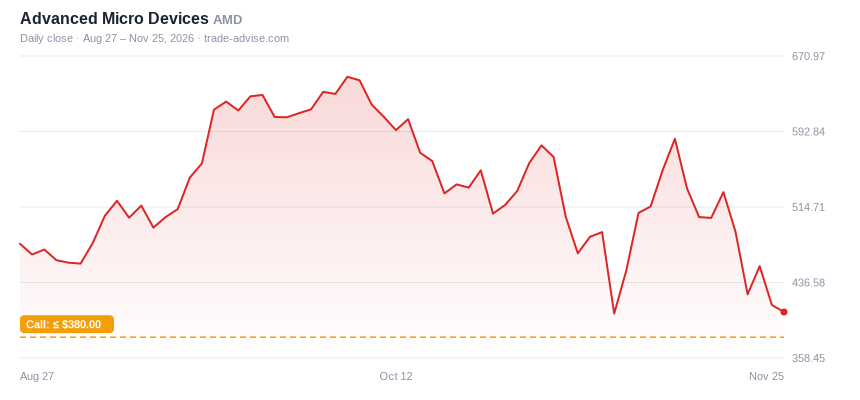
Tuesday's session dismantled that reading in six hours. NVIDIA (NVDA) gapped 3.62% lower and closed down 8.11% at $151.66, finishing within a dollar of its session low, while Advanced Micro Devices (AMD) opened 6.16% below its prior close and surrendered 12.48% to $396.85 — the bottom of its 90-day range and 39.7% beneath the high of that range. The Economic Times recorded the Dow up 0.36% against a Nasdaq down 1.11%, a 147-basis-point index spread in a single session. A governance change at one company does not alter the funding arithmetic facing an entire cohort, and the market spent Tuesday relearning that.
The Spread
From AMD's close to Visa (V) at $414.00, up 1.12%, the session dispersion ran 1,360 basis points — an enormous gap between two constituents of the same correction, facing the same discount rate, on the same afternoon. Seven of the ten largest names closed lower. The three that did not were a payments network, a software franchise, and a hardware company with the most predictable installed-base cash flows in the index. Reuters attributed the broad fade to looming US tariffs alongside the fizzling AI rebound, and the follow-through was visible overnight, with CNBC reporting a rout across Japanese and Korean semiconductor names and SoftBank down 14%.
| Symbol | Close | Change | Day range | 52-week range |
|---|---|---|---|---|
| AAPL | $354.07 | +4.99 (+1.43%) | $345.88–$354.40 | $243.42–$360.83 |
| MSFT | $496.13 | +3.63 (+0.74%) | $488.43–$501.82 | $349.20–$559.15 |
| NVDA | $155.38 | -9.67 (-5.86%) | $150.50–$159.92 | $124.50–$243.37 |
| GOOGL | $279.05 | -3.05 (-1.08%) | $276.03–$281.78 | $264.22–$408.61 |
| AMZN | $252.29 | -3.10 (-1.21%) | $250.53–$255.56 | $196.00–$287.20 |
| META | $589.82 | -7.78 (-1.30%) | $584.26–$600.32 | $520.26–$779.82 |
| TSLA | $384.68 | -0.78 (-0.20%) | $375.50–$390.09 | $297.38–$498.83 |
| JPM | $317.10 | +0.44 (+0.14%) | $313.62–$319.01 | $279.10–$366.50 |
| V | $416.78 | +7.38 (+1.80%) | $407.40–$416.87 | $293.89–$442.23 |
| AMD | $413.27 | -40.19 (-8.86%) | $396.01–$428.87 | $188.22–$658.52 |
Three names closed at the very bottom of their 90-day ranges on Tuesday — AMD, Alphabet at $277.07, and JPMorgan at $314.68 — while Visa logged a third consecutive green close.
That trio matters more than the dispersion itself. Alphabet and JPMorgan are not compute-capex proxies in any meaningful sense, and their simultaneous arrival at 90-day lows suggests the repricing has migrated well past the semiconductor complex. My call for JPMorgan (JPM) to break below $310 remains open, and Tuesday's 0.63% decline to a fresh range low moved it closer.
Winner's Case
Over thirty sessions Visa has gained 5.3% while NVIDIA has lost 32.5% and AMD 32.4%, a relative-performance gap of roughly 37 percentage points inside a single index. The argument for that cohort has not changed: businesses that convert revenue to free cash flow without committing years of capital to depreciating silicon are being awarded a scarcity premium in a market that has abruptly rediscovered the cost of money. I called for Visa to clear its 90-day high of $432.48 and it has not — the stock sits 4.3% below that mark, which is the honest correction to make. Leadership here is relative rather than absolute, and that distinction matters for anyone sizing the position as a hedge rather than a return engine.

The obvious defensive expression is Visa, and the crowd has found it. The less recognized beneficiary is Apple (AAPL), which closed up 0.51% at $350.86 for a second consecutive green session and sits just 2.0% below its 90-day high — the only megacap in the group within shouting distance of its highs, with a thirty-session gain of 1.3% achieved while Meta fell 23.3% and Alphabet 22.2%. Microsoft (MSFT) also closed green at $495.21, but it rests a mere 0.7% above its 90-day low after a 9.5% thirty-session decline; the quality bid is considerably narrower than its advance-decline line implies.
Loser's Case
The contrarian argument for the compute names is that the de-rating has stopped compounding. NVIDIA's five-session change is just -2.3% despite a 31.5% advance and an 8.11% reversal inside that window, and it now sits 10.6% above its 90-day low rather than pressed against it. Two-way violence of that magnitude with a roughly flat net result is characteristic of a de-rating entering its distribution phase rather than its liquidation phase. Steve Liesman's observation at CNBC that the NVIDIA whiplash complicates Chairman Warsh's stated preference for reading market signals cuts in the bulls' favor: a Federal Reserve genuinely responsive to asset prices is an easing option written to the longest-duration equities in the market, and nothing in the index owns more duration than semiconductor capital expenditure.

AMD is the purer version of that bet and the weaker one. A company trading nearly 40% below where it stood three months ago has already absorbed an enormous revision to forward order assumptions; the difficulty is that Tuesday's decline arrived on a downside gap that was never filled and a close within a couple of percent of the session low, which is the signature of a repricing still searching for a clearing level.
Where the Weight Falls
The evidence continues to favor the cash-generative side, with less margin than a month ago. A one-day, politically catalyzed trillion-dollar move that reverses by a third in the following session tells you the marginal buyer of compute exposure is transacting on headlines rather than on earnings quality, and markets that trade on headlines do not form durable lows. My expectation is that AMD closes below $380.00 within ten sessions and that Visa reclaims $420.00 over the same window, extending the relative spread; a NVIDIA close back above Tuesday's $159.89 high within five sessions would tell me the forced phase of this de-rating is finished and I would retire the call. What would genuinely reverse the view is an AMD close above $428.65 — the session's high — within ten sessions, because that would reframe the last two weeks as position liquidation rather than multiple compression, and the two require opposite allocations.
Until the compute cohort can hold a gain for more than one session without a political catalyst underwriting it, capital belongs with the companies that already earn their cost of capital.