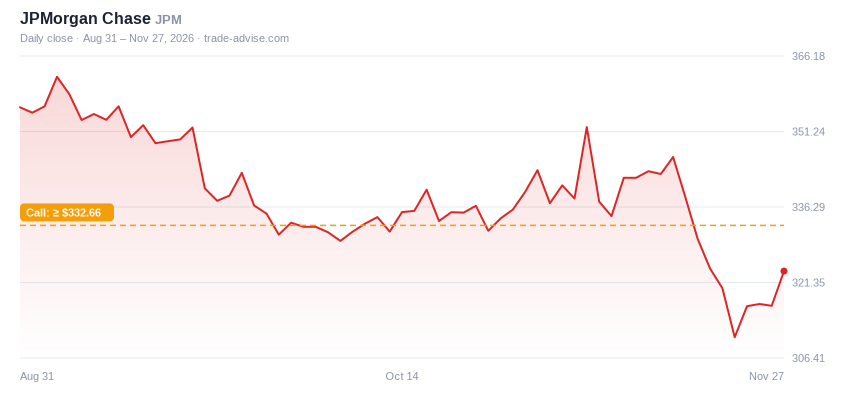
The consensus reading of Friday's holiday-shortened session, which ended at 1 p.m. ET after the Thanksgiving break, is that technology carried the rebound once again and that JPMorgan Chase (JPM) merely caught the updraft. On that reading its 2.17% gain to $323.60, which beat the 1.69% advance in the SPDR S&P 500 ETF (SPY) by 48 basis points, is a footnote to a relief rally led by the most beaten-down growth names, and it will fade when the bounce does.

The data points elsewhere, because what matters about JPMorgan's move is the price at which those earnings are offered: 13.0x trailing earnings against a 23.1x median for the ten large-cap stocks tracked here, with earnings per share up 17.9% year on year and the stock valued at just 5.6 times free cash flow. In a correction that CNBC dates to Nov. 20, the first since April 2025, the market is learning to rank earnings by what it pays for them, and a bank compounding at high-teens rates for a low-teens multiple belongs near the top of that ranking. I owe readers an admission on this name: my call that JPMorgan would close above $350.00 assumed margin expectations would lift the stock, and the correction reached the banks instead and pushed the shares to $316.74 by Wednesday's close. The companion view from The Correction Just Spread to JPMorgan, that the stock would close below $310.00 by Dec. 2, now sits $13.60 beneath Friday's close with three sessions left, and it looks equally mistimed.
The Regime Question
Friday did not change the regime, however loud the rebound sounded; it confirmed the one that has been forming since late October, in which capital is migrating from expensive growth toward cheap or defensive earnings and uses every rally in technology as a chance to reprice rather than to re-rate. The Technology Select Sector SPDR (XLK) rose 2.84% on the day, yet it remains down 15.3% over 30 sessions and closed 12.1% below its 50-session average, while the Financial Select Sector SPDR (XLF) is up 3.5% over the same 30 sessions. A one-day reversal of 2.84% against a cumulative spread of roughly 1,880 basis points in favor of financials is a countertrend move inside an established rotation, and JPMorgan outrunning both the broad market and its own sector, by 98 basis points against the financials fund, is what that rotation looks like at the level of a single name.
| Symbol | Close | Change | Day range | 52-week range |
|---|---|---|---|---|
| AMD | $425.86 | +19.83 (+4.89%) | $398.59–$426.88 | $188.22–$658.52 |
| V | $430.59 | +6.20 (+1.46%) | $423.02–$432.01 | $293.89–$442.23 |
| JPM | $323.60 | +6.86 (+2.17%) | $321.37–$324.99 | $279.10–$366.50 |
| TSLA | $400.36 | +20.22 (+5.32%) | $384.66–$401.18 | $297.38–$498.83 |
| META | $630.00 | +20.11 (+3.30%) | $620.80–$636.62 | $520.26–$779.82 |
| AMZN | $254.24 | +9.81 (+4.01%) | $248.45–$255.27 | $196.00–$287.20 |
| GOOGL | $274.78 | +1.68 (+0.62%) | $270.03–$279.52 | $262.73–$408.61 |
| NVDA | $150.62 | +1.32 (+0.88%) | $145.39–$151.98 | $124.50–$243.37 |
| MSFT | $493.38 | +3.45 (+0.70%) | $488.83–$500.47 | $349.20–$559.15 |
| AAPL | $358.70 | +3.12 (+0.88%) | $355.64–$359.50 | $243.42–$360.83 |
The Evidence
Begin with participation, because the volume figures cut against the lead story's framing in an instructive way. The Invesco QQQ Trust (QQQ) traded 4.3 times its 20-session average volume on a half-day session and the S&P 500 fund 2.2 times, while JPMorgan traded at 1.0 times its average and the financials fund at only 0.7 times. Money moved into the rebound through technology, and the banks gained without any surge in activity, which suggests that the case for cheap financial earnings has not yet been reflected in positioning even as the price action begins to favor it.

The defensive complex tells the same story from another angle. The Consumer Staples Select Sector SPDR (XLP) closed at its 90-day high after three consecutive green closes and a 30-session gain of 7.0%, the utilities fund has strung together four straight green closes, and Visa (V), at a 61.2% operating margin, finished at $430.59 for its fourth consecutive advance, clearing the $420.00 level I flagged last week. Late-cycle markets reward earnings quality and penalize duration, and the leadership board over the past month reads like a textbook example of that preference, with staples, payments and now the largest American bank ahead of the semiconductor complex.
The speculative end of the market, meanwhile, rallied hardest, which is the signature of a relief bounce rather than a change in leadership. Tesla (TSLA), priced at 466.0 times trailing earnings with earnings per share down 39.2% year on year, led the list with a 5.32% gain, and Advanced Micro Devices (AMD), at 91.4 times, rose 4.89% even as Erste Group analyst Hans Engel downgraded it on valuation concerns. Abroad, The Telegraph reported that Beijing took fresh steps to shield its markets from the global tech crash, sending the Shanghai Composite up more than 4%. Policy backstops of that kind tend to arrive in the late stages of a drawdown: they can steady prices, but they rarely restore the multiples that expensive growth enjoyed at the peak.
Historical Precedent
The period that rhymes most closely is the unwinding that followed the technology peak of March 2000, when sharp and frequent rallies in the Nasdaq leaders repeatedly drew capital back toward the old favorites, only for leadership to keep shifting toward lower-multiple businesses with visible cash generation, among them the large banks, consumer staples and industrial franchises. The lesson of that cycle was that the relief rallies were real and often violent, which made them easy to misread as a resumption of the prior regime, while the relative-performance spreads kept widening in favor of cheap earnings for far longer than most allocators expected. Friday's combination of a strong technology bounce with defensives at 90-day highs and a bank at 13.0 times earnings outperforming the index carries that same structure.

The Position
The weight of evidence suggests that JPMorgan's outperformance is the early expression of a rotation into underpriced earnings quality, one the market has not yet fully positioned for, and that technology's Friday surge was a rally inside a correction rather than its end. On that reading JPMorgan should close above its 20-session average of $332.66 within the next 20 days, while a close back below Wednesday's $316.74 would show that the banks remain hostage to the broader de-rating and would prove the view wrong. Investors would do well to consider that the cheapest large-cap earnings on the board belong to a bank compounding at nearly 18%, and I expect that discount to narrow before the year is out.