The consensus reading of Wednesday's session is the one CNBC put in its headline: the Huang comeback rally fizzled, AI concerns returned, and investors sold the whole complex as they weighed AI spending, inflation and the risk of higher rates. On that reading the day was simply one more leg of an indiscriminate de-rating in technology, and the only open question is how far it runs before the holiday drains liquidity from the market.

The data tells a more selective story. Seven of the ten megacaps closed lower, yet Meta Platforms (META) finished up 3.40% at $609.89 while NVIDIA (NVDA) fell 3.91% to $149.30, and Visa and Apple also closed higher; the market was not liquidating AI exposure so much as repricing it around cash conversion, rewarding the companies that turn the AI build-out into free cash flow and discounting the ones whose value now depends on the build-out continuing at its recent pace. That distinction matters for allocation over the next month, because a selloff with dispersion this wide is a market expressing views, and views tend to persist longer than panic does.
The Spread
The widest gap of the session, 731 basis points between Meta and NVIDIA, is all the more telling because both names opened under pressure: NVIDIA gapped 7.29% below Tuesday's $155.38 close to open at $144.06, while Meta gapped 2.45% lower to open at $575.34. From there the paths separated decisively, with Meta climbing 7.4% off its $567.75 low to finish within $1.17 of its $611.06 high, while NVIDIA's recovery from $141.17 ran out of momentum beneath $150.37 and left the stock with a loss of nearly four percent. The dispersion inside the hyperscaler group was almost as wide, since Meta outperformed Amazon, down 3.12%, by 652 basis points, and also beat Alphabet and Microsoft, which fell 2.13% and 1.25% respectively. Volume confirms that this was a deliberate repricing and not a disorderly flush, with NVIDIA trading at 1.1 times its 20-session average and Meta at exactly its average, which is not the signature of capitulation in either direction.
| Symbol | Close | Change | Day range | 52-week range |
|---|---|---|---|---|
| AMD | $406.03 | -7.24 (-1.75%) | $370.40–$407.77 | $188.22–$658.52 |
| V | $424.39 | +7.61 (+1.83%) | $413.47–$426.67 | $293.89–$442.23 |
| JPM | $316.74 | -0.36 (-0.11%) | $309.49–$318.41 | $279.10–$366.50 |
| TSLA | $380.14 | -4.54 (-1.18%) | $357.64–$383.73 | $297.38–$498.83 |
| META | $609.89 | +20.07 (+3.40%) | $567.75–$611.06 | $520.26–$779.82 |
| AMZN | $244.43 | -7.86 (-3.12%) | $235.96–$246.56 | $196.00–$287.20 |
| GOOGL | $273.10 | -5.95 (-2.13%) | $262.73–$273.62 | $262.76–$408.61 |
| NVDA | $149.30 | -6.08 (-3.91%) | $141.17–$150.37 | $124.50–$243.37 |
| MSFT | $489.93 | -6.20 (-1.25%) | $477.39–$493.44 | $349.20–$559.15 |
| AAPL | $355.58 | +1.51 (+0.43%) | $345.13–$356.75 | $243.42–$360.83 |
Winner's Case
Meta's outperformance rests on a valuation regime that the rest of the spending cohort cannot match: the market is paying 20.0 times trailing earnings for 29.8% earnings growth and 27.5% revenue growth, against a median P/E of 23.0x across the ten tracked names, while an 81.0% gross margin gives the advertising engine room to absorb heavy infrastructure outlays. The more decisive ratio is price to free cash flow, where Meta sits at 36.8x against 51.6x for Alphabet, 61.5x for Microsoft and a striking 173.8x for Amazon, so in a phase of the cycle where investors question the return on AI capital, the spender that already converts most of its revenue into cash earns the benefit of the doubt. This is the classic late-cycle pattern in any capital-spending boom, in which the market stops rewarding capacity for its own sake and starts paying for monetization, and Meta also enters that phase already de-rated, having fallen 17.3% over thirty sessions to close just 0.9% below its 20-session average with a 14-session RSI of 46. The rotation shows up beyond Meta as well: Visa logged its third consecutive green close and is up 8.4% over thirty sessions, confirming my call for Visa above $420.00 with Wednesday's close at $424.39. Goldman Sachs, as reported by Business Insider, finds hedge funds cutting equity exposure while longer-term investors remain heavily invested, which is consistent with capital rotating toward cash-generative franchises within equities rather than fleeing the asset class.

Loser's Case
The case for NVIDIA from here deserves the same rigor, because on fundamentals it is the cheapest growth among the ten: 16.6 times trailing earnings for 130.5% earnings growth and 93.3% revenue growth, an operating margin of 65.5% that is roughly double the group median of 33.1%, and a price to free cash flow of 25.2x that is lower than Meta's. What the market is pricing versus what is happening has rarely diverged so sharply in a megacap, and the explanation lies in governance rather than in operations; CNBC reports that Jensen Huang is back as chief executive after President Trump urged the board to rehire him, while the investigation into the company, its executive leadership and its board continues and lawsuits mount. Governance discounts of this kind tend to narrow once the legal overhang resolves, and the business beneath this one is producing earnings at a pace that justifies a richer multiple than it carries, which is why a patient allocator could argue that the loser of Wednesday's spread offers the better risk-adjusted return over a full cycle. I should own my record here, having twice called NVIDIA to close below $135.63 and been wrong both times; Huang's reinstatement turned the stock before any close confirmed the break, and Wednesday's finish sits 18.9% above its 90-day low, a reminder that a governance shock can reverse faster than an earnings de-rating.

NVIDIA ended Wednesday 26.7% below its 50-session average while trading at a lower multiple of free cash flow than Meta.
Where the Weight Falls
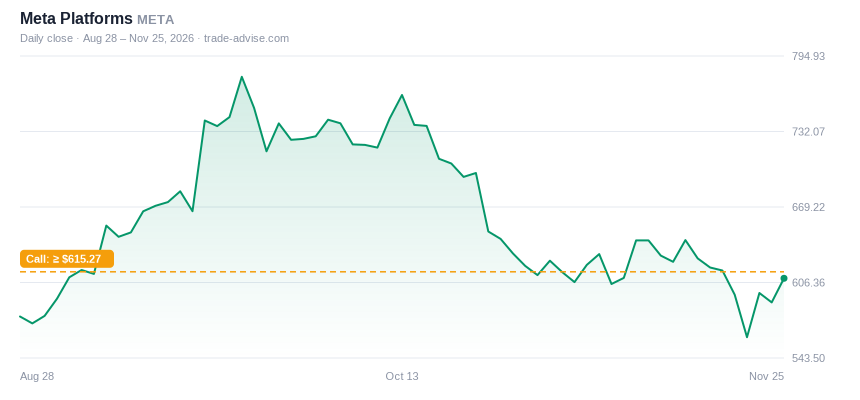
The weight of evidence nonetheless favors Meta's side of the spread over the coming weeks, because NVIDIA's discount is not something investors can underwrite on a spreadsheet: it depends on the outcome of an investigation whose timing nobody controls, and NVIDIA's own 30-session decline of 32.5% shows how quickly that uncertainty compounds when rate risk is rising at the same time. Meta, by contrast, offers a valuation the market can measure, a free cash flow profile that stands apart within the spending cohort, and a price that has only to recover its 20-session average of $615.27 to confirm that Wednesday's reversal marked a change in leadership rather than a single session of relief. The ratio that would change my mind is NVIDIA's distance from its own 20-session average, now 13.4%; if NVIDIA were to close back above $172.48 before the board investigation resolves, it would mean the market is again paying for raw growth over cash conversion, and Meta's relative advantage would erode with it. Equally, a Meta close back below Wednesday's $567.75 low would show the reversal was positioning noise and not a reallocation of capital.
Meta closes above its 20-session average of $615.27 within ten sessions, and the cash-conversion trade it now leads keeps beating NVIDIA's governance-discounted growth until the investigation is resolved.