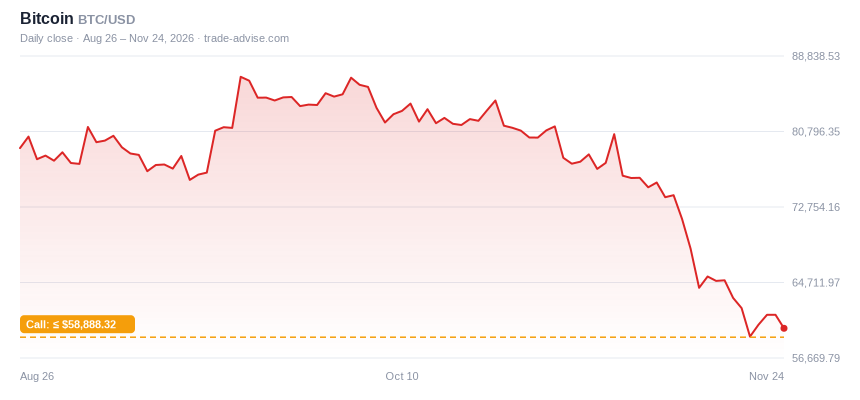
The CFTC made its event-contract reporting rules permanent on Tuesday, and more firms are lining up to launch prediction markets in the US. Same session, Utah's attorney general moved to dismiss criminal charges against Kalshi after the company halted services in the state. A venue carrying a $40 billion valuation got regulatory daylight on two fronts in one day, and the asset class that spent four years claiming to be the home of permissionless speculation closed red across seven of its eight largest names.

Don't mistake that for a causal link on the session. It isn't. Bitcoin's 1.38% slide to $60,427.80 coincided with tariff nerves bleeding out of US equities, and the overnight push stalled at $61,682.01 before sellers took it to $59,455.31. The $60,000 handle was lost and clawed back. Standard stuff for a market that has given up 24.5% in thirty sessions.
The slower story is the one worth your attention. Prediction markets offer the same thing alt-season offered — binary risk, high velocity, a scoreboard — minus the seed phrase, the bridge, and the exchange counterparty you have to trust until the morning you don't. Coinkite spent Tuesday explaining how five years of security reviews missed a Coldcard wallet flaw and said it hasn't decided on compensation. Cash-settled event contracts under a federal reporting regime don't have that problem. Anyone who sat through 2022 knows exactly how much that matters when the cycle turns.
Speculative capital doesn't vanish; it relocates. The question nobody in crypto wants to ask out loud is whether a regulated, dollar-denominated casino with a CFTC stamp pulls the marginal retail dollar that used to buy Dogecoin on Friday night.
What Didn't Happen
BlackRock launched a tokenized money market fund in Hong Kong that accepts stablecoin subscriptions, seeded with roughly $100 million, with Standard Chartered and Ant International participating. Switzerland's central bank, UBS and SIX announced a study into a shared ledger carrying central bank money, commercial bank money and securities on one platform. South Korea proposed ending its 2017 ICO ban.
| Symbol | Close | Change | Day range | 52-week range |
|---|---|---|---|---|
| BTC/USD | $59,832.00 | -1,438.93 (-2.35%) | $59,260.00–$61,682.01 | $55,130.00–$97,924.49 |
| ETH/USD | $1,680.11 | -30.54 (-1.79%) | $1,664.18–$1,721.88 | $1,507.05–$3,444.01 |
| SOL/USD | $69.69 | -2.34 (-3.25%) | $68.57–$72.69 | $60.13–$148.74 |
| BNB/USD | $548.62 | -8.03 (-1.44%) | $543.26–$562.19 | $503.75–$959.52 |
| XRP/USD | $0.9251 | -0.0156 (-1.66%) | $0.9093–$0.9615 | $0.8600–$2.4172 |
| ADA/USD | $0.1446 | -0.0040 (-2.69%) | $0.1425–$0.1509 | $0.1333–$0.4842 |
| DOGE/USD | $0.0553 | -0.0011 (-1.95%) | $0.0544–$0.0572 | $0.0508–$0.1568 |
| AVAX/USD | $6.5770 | -0.2150 (-3.17%) | $6.4740–$6.8720 | $5.6810–$15.2700 |
Three sovereign-or-near-sovereign adoption headlines in a single session. ETH/USD closed down 0.75% at $1,697.79, its second straight red close, sitting 38.8% below its 90-day high.
Every major on the board is between 2.2% and 4.7% above its 90-day low. Eight names, one position.
That is the signal. Institutional rails keep getting built and the tokens keep not caring, because the thing being tokenized is Treasury bills and settlement finality — neither of which needs ETH or SOL to appreciate. The infrastructure narrative and the token price decoupled a while ago; Tuesday was just another day of confirmation.
Credit where it's due on the one name that held: XRP/USD closed $0.9443, up 0.38%, its second consecutive green close and the only gainer on the board. Thin, but it's something.
Now the ledger on my own calls. I twice argued bitcoin would reclaim $65,000 — once at $65,200 — and both expired worthless. What I got wrong was assuming the AI-complex bounce would transmit into crypto the way it did all year. It didn't, and Arthur Hayes has been making the harder version of that argument: the Nvidia rally itself is bearish for crypto, because capital chasing equity beta has no reason to pay up for the leveraged crypto proxy. On Monday I said BTC trades below $60,386 within five sessions. Tuesday's low printed $59,455.31.
So where does this break. Bitcoin's 90-day floor is $58,888.32, and Tuesday's close sits 2.6% above it. That floor held through the trust-failure weekend and it held through the Nvidia headfake. A close beneath it with the complex already compressed into a three-point band above its 90-day lows is the condition under which this stops being a drawdown and becomes a liquidation. Conversely, if bitcoin closes back above $61,682.01 inside five sessions, the distribution read is wrong and the AI trade is pulling crypto along after all.
The Line
$58,888.32 — below it, there is no reference left within ninety days.