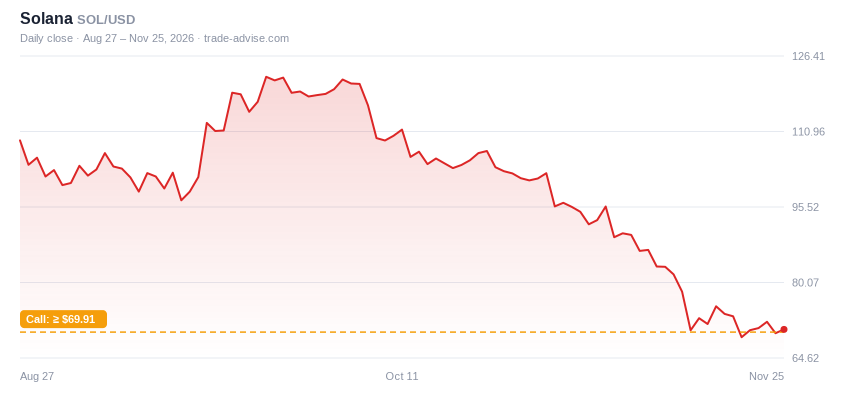
SBI Holdings and Sumitomo Mitsui Financial Group formed a joint venture, SBI Solana Global, to build stablecoin payment infrastructure, explore AI agent micropayments and tokenize financial assets. Hong Kong's Monetary Authority launched a tokenized debt platform the same day, handling issuance, interest payments and repayment at maturity with 24-hour settlement in multiple currencies. SOL/USD closed at $67.86, down 2.63% and at the floor of its 90-day range. The settlement layer is being underwritten by regulated Asian balance sheets while the asset layer is being priced as a leveraged expression of the Nasdaq.

What Shipped
The two announcements solve different problems and point the same direction. SBI Solana Global is a distribution decision: two of Japan's largest financial institutions selecting a specific public chain for payment rails rather than building a permissioned ledger. The technical rationale is unremarkable and that is the point — sub-cent transaction costs and fast deterministic finality are prerequisites for micropayments, and a bank cannot run a yen-denominated settlement corridor on a chain where fees are volatile.
| Symbol | Close | Change | Day range | 52-week range |
|---|---|---|---|---|
| BTC/USD | $60,458.01 | +626.01 (+1.05%) | $57,300.38–$60,568.01 | $55,130.00–$97,924.49 |
| ETH/USD | $1,692.65 | +12.54 (+0.75%) | $1,608.86–$1,698.72 | $1,507.05–$3,444.01 |
| SOL/USD | $70.47 | +0.78 (+1.12%) | $65.84–$71.07 | $60.13–$148.74 |
| BNB/USD | $554.03 | +5.41 (+0.99%) | $526.72–$555.87 | $503.75–$959.52 |
| XRP/USD | $0.9379 | +0.0128 (+1.38%) | $0.8889–$0.9489 | $0.8600–$2.4172 |
| ADA/USD | $0.1459 | +0.0013 (+0.90%) | $0.1356–$0.1480 | $0.1333–$0.4842 |
| DOGE/USD | $0.0561 | +0.0008 (+1.45%) | $0.0522–$0.0564 | $0.0508–$0.1568 |
| AVAX/USD | $6.6320 | +0.0550 (+0.84%) | $6.2430–$6.6530 | $5.6810–$15.2700 |
Hong Kong's platform is the more interesting engineering claim. Most tokenized debt pilots tokenize issuance and leave coupon payments and redemption in legacy systems, which preserves the reconciliation burden the technology was supposed to eliminate. Covering the full instrument lifecycle with round-the-clock settlement is what makes the asset composable with anything else onchain. Separately, the European Banking Authority asked the European Commission to write rules for firms offering DeFi lending — the regulatory perimeter is being drawn around protocols that were previously outside it.
Network Effects
Each regulated issuer that commits to a chain brings its counterparty graph with it. A Japanese bank stablecoin is not valuable in isolation; it becomes valuable when corporate treasury clients, settlement banks and tokenized collateral issuers share the same execution environment. That compounding is slow and mostly invisible in daily pricing, which is why Tuesday's session told you nothing about it.

The machine-payment thread deserves attention. Agent-to-agent micropayments have been a theoretical use case for years, waiting on two conditions: a settlement layer cheap enough for sub-dollar transactions and an installed base of autonomous software with a reason to transact. Compute capacity is being built at a scale that now includes the FCC authorizing SpaceX to deploy satellites for orbital AI data centers. Whether agents actually need onchain settlement rather than existing payment processors is genuinely unresolved, and it is too early to underwrite that case.
Six of eight majors closed Tuesday at the bottom of their 90-day ranges. The eight-name average 30-session decline is 29.4%, with dispersion between the best and worst performer of just 6.1 percentage points.
The Investment Thesis
Every major finished lower, and all eight closed in the lower third of their session range. ETH/USD lost 2.29% to $1,641.66, underperforming Bitcoin by roughly half a percentage point, with CoinDesk noting DeFi assets fell harder still. BTC/USD at $58,773.09 confirmed the deleveraging read I made on Monday.

I have been wrong on Ethereum twice this month, calling for closes above $2,437.10 and $2,136.77 that never came. The error was treating tokenization progress as something the market would price within weeks. It is not. When Nvidia, Micron and other AI-linked equities sold off Tuesday and the Nasdaq fell 1.11%, crypto moved with them — the complex is currently a high-beta risk asset and nothing in the regulatory or protocol news flow changes that correlation on a monthly horizon.
The durable position is simpler. Over a six-to-twelve month window, the chains that regulated institutions select for settlement accrue fee revenue, stablecoin float and counterparty density that does not reverse when equities correct. Solana now has a Japanese bank venture; Ethereum retains the deepest tokenization footprint; Hong Kong's platform is chain-agnostic for now. Buying the drawdown requires conviction that institutional selection decisions made in 2026 are binding for a decade, and that conviction is not the same thing as a view on December.
What to Watch Next
Solana reclaiming $69.91, Tuesday's high, on a closing basis within 10 sessions would be the first evidence that the SBI venture is being priced rather than ignored. Absent that, correlation to equity risk remains the dominant variable, and Bitcoin extending toward its 52-week low of $55,130.00 within 20 sessions would confirm it. Ethereum closing below its 90-day low of $1,621.84 within five sessions invalidates any near-term stabilization read — my pending call for a close above $1,845.07 by December 9 looks increasingly unlikely.
What would change my mind on the broader correlation thesis: stablecoin supply on Solana expanding materially in the first quarter alongside a concrete launch timeline from SBI Solana Global, or the European Commission publishing a DeFi lending framework that clears institutional participation rather than restricting it. Ukraine's regulatory regime does not take effect until July 2027, which is a useful reminder of how these timelines actually run.
Institutional settlement decisions are being made now and will be visible in network economics long after this drawdown is a footnote.