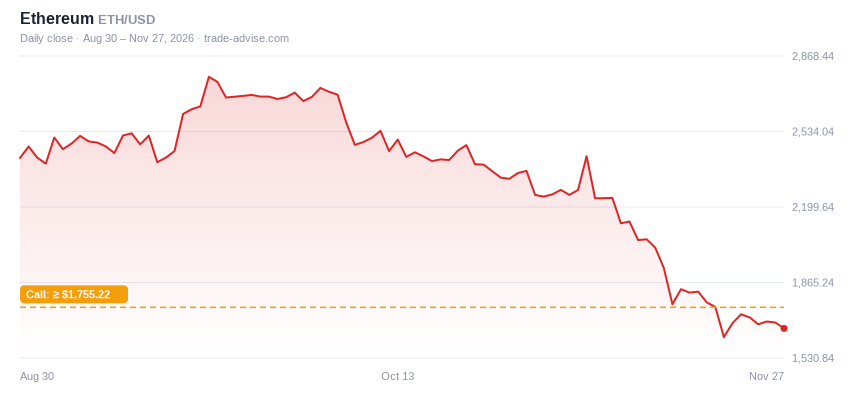
Ethereum's DeFi layer lost just 1.0% of its value locked over the past seven days, leaving $36.5 billion in place, the shallowest weekly decline among the chains we follow. The price has not followed: ETH/USD is trading at $1661.87, down 1.66% and the weakest of the large caps on Friday, and I read that gap as price lagging an ecosystem that is holding its shape better than the market currently credits.

The backdrop matters for how much weight that reading can bear. The Crypto Fear & Greed Index sits at 12, unchanged from a week ago and deep in extreme fear. Value locked across all chains is $68.6 billion, down 2.5% on the week and 19.1% over 30 days. In that environment, the useful question is less which tokens bounced and more which ecosystems kept their capital when there was every reason to pull it.
I should be plain about my own record here. My calls for ether above $2,437.10 and above $2,136.77 both failed, with ETH sliding as low as $1,623.09, now its 90-day low. What I underestimated was the length of the lag between ecosystem resilience and price in a market where even bullish research desks are retreating; Galaxy Research this week told readers, as reported by Decrypt, "We withdraw our call that the bear market ended in June." The ecosystem argument still holds, but I now treat its arrival in price as a slower process.
The Divergence
Solana is the cleaner comparison. SOL/USD is up 0.76% at $71.5700, holding above its 90-day low of $68.88 after two consecutive green closes. My earlier read that Solana would hold above $69.91 has already been confirmed, as set out in Two Asian Institutions Picked Solana the Same Day It Printed a 90-Day Low at $67.86.
| Symbol | Close | Change | Day range | 52-week range |
|---|---|---|---|---|
| AVAX/USD | $6.6050 | +0.0090 (+0.14%) | $6.4810–$6.8220 | $5.6810–$15.2700 |
| DOGE/USD | $0.0577 | +0.0012 (+2.12%) | $0.0563–$0.0591 | $0.0508–$0.1566 |
| ADA/USD | $0.1483 | -0.0003 (-0.20%) | $0.1457–$0.1539 | $0.1333–$0.4842 |
| XRP/USD | $0.9483 | +0.0045 (+0.48%) | $0.9312–$0.9874 | $0.8600–$2.4172 |
| BNB/USD | $554.68 | +0.47 (+0.08%) | $542.85–$568.30 | $503.75–$959.52 |
| SOL/USD | $71.57 | +0.54 (+0.76%) | $70.12–$73.93 | $60.13–$148.74 |
| ETH/USD | $1,661.87 | -27.98 (-1.66%) | $1,634.03–$1,755.22 | $1,507.05–$3,444.01 |
| BTC/USD | $59,896.38 | -680.80 (-1.12%) | $58,792.37–$62,248.91 | $55,130.00–$97,924.49 |
On the ecosystem side the order reverses. Solana's value locked stands at $4.6 billion, down 2.8% over seven days, almost three times Ethereum's weekly decline. Over 30 days the two chains are nearly level, Solana down 18.9% and Ethereum down 19.5%, so this is a short-window divergence and should be read as one. Still, the direction is informative: because Ethereum fell less than the market this week, its share of all value locked edged up from roughly 52.4% to 53.2%.
Value locked on Bitcoin's DeFi layer fell 28.8% in seven days and 43.9% over 30 days, to $2.3 billion.
Why They Diverged
Price reflects the marginal flow; value locked reflects the stock of commitments. Forexlive described ether as consolidating near yearly lows with some broad short-covering but no positive catalyst behind it, which fits a token being sold as a macro instrument while its application layer sits largely undisturbed. ETH's 14-session RSI of 29 and a price 9.1% below its 20-session average of $1,857.56 describe that pressure well.

The protocol-level explanation is about the type of capital each chain holds. Ethereum's DeFi base is weighted toward lending markets and long-dated collateral positions, which are slow and costly to unwind. Solana's activity leans toward trading, and trading liquidity is the first thing to thin when sentiment collapses. Bitcoin's DeFi layer is the extreme case: it is the youngest of these ecosystems and depends on wrapped and bridged collateral, which is exactly the capital that leaves first.
BNB Chain offers a third model. According to Cointelegraph, it has detailed a new layer-1 for trading, private finance and AI that will run alongside BNB Smart Chain and keep BNB as its native token, with a public testnet targeted for the first quarter of 2027. The announcement did not slow the near-term drain: value locked on BSC fell 3.3% this week to $4.3 billion, the steepest weekly drop among the major smart-contract chains.
Which Ecosystem Is Compounding
Network effects in DeFi are winner-take-most because composability rewards depth. Every lending market that keeps its deposits makes the next protocol built on top of it more useful, and that usefulness is what holds capital in a drawdown. The consensus answer to "who is compounding" right now is Solana, and its relative price strength shows that view is already priced. The less obvious case is Ethereum, where capital stickiness through a week of extreme fear is not reflected in the token at all.

BNB Chain's specialized layer-1 is the more interesting long-dated bet. Keeping BNB as the native token means any activity the new chain attracts accrues to the existing asset, so the token's holders are the less obvious beneficiary. It is too early to tell whether that design draws builders, and a testnet more than a month away supports an observation about strategy, not a verdict on adoption.
The Cycle Position
My 6-to-12-month view is that Ethereum sits in the early-majority phase of DeFi settlement, where the deepest collateral base keeps compounding while application-layer experiments come and go on faster chains. Cointelegraph reports that the seven-day average of Bitcoin's supply profit/loss ratio has hit an 11-year low, a capitulation signal that tends to appear late in drawdowns rather than early. The next inflection for Ethereum is the point where its 30-day value-locked change stops falling, which would show the commitment base stabilizing as well as merely outlasting its peers.
The 20-day checkpoint on that view is specific. A daily ETH close above $1755.22, today's session high, within 20 days would show price beginning to catch up with the ecosystem. A close below the 90-day low of $1,623.09 within that window would mean the lag is longer than I am allowing for, and I would set the argument aside until the value-locked data turned. What would change my mind sooner is Ethereum's weekly value-locked decline beginning to match or exceed the market's, since that would remove the stickiness the whole reading rests on.
Capital that stays through extreme fear is the capital that builds the next cycle, and on that measure Ethereum is quietly ahead of its price.