South Korea just proposed taking the exchange business away from the people who built it. The draft digital asset bill heading to the legislature caps any single shareholder in a domestic exchange at 20%, requires banks to hold majority ownership of every won-denominated stablecoin issuer, and opens a path for domestic ICOs. Korea is converting its venue layer into supervised utilities, and the sequencing tells you why: the bill landed the same session Bithumb warned users about phishing campaigns after a deeper probe into its October breach turned up more than first reported.

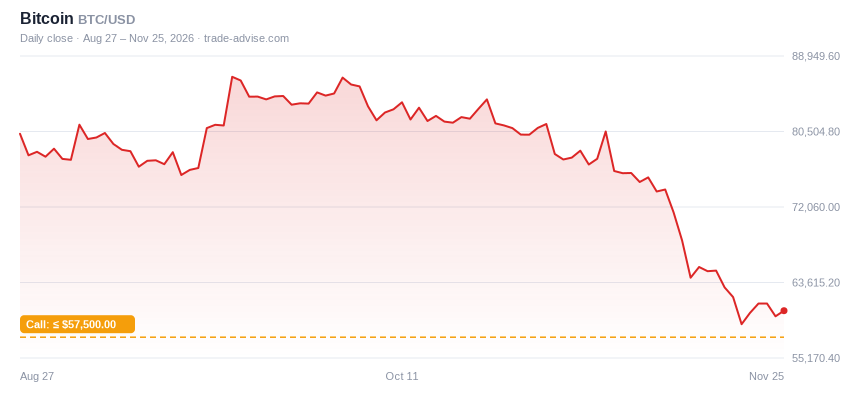
None of that moved price. Wednesday's selling was macro — US core inflation at 3.8% ahead of the December Fed meeting, renewed tariff anxiety, and a Nasdaq down 4%. Crypto has been trading as a beta sleeve on US equities all week and did it again. BTC/USD closed at $58,773.09, off 1.77%.
What Changed
The strangest clause is the fintech carve-out. Banks must own a majority of each won stablecoin issuer, but a fintech can still be the single largest shareholder — a structure built so the Naver and Kakao tier keeps a seat at the table while bank balance sheets absorb the redemption risk. Meanwhile that 20% ownership cap re-opens the biggest live question in Korean crypto, complicating Naver Financial's planned takeover of Upbit's operator and reshaping who controls Bithumb and Gopax. One clause, and the entire M&A map gets redrawn.
| Symbol | Close | Change | Day range | 52-week range |
|---|---|---|---|---|
| BTC/USD | $60,458.01 | +626.01 (+1.05%) | $57,300.38–$60,568.01 | $55,130.00–$97,924.49 |
| ETH/USD | $1,692.65 | +12.54 (+0.75%) | $1,608.86–$1,698.72 | $1,507.05–$3,444.01 |
| SOL/USD | $70.47 | +0.78 (+1.12%) | $65.84–$71.07 | $60.13–$148.74 |
| BNB/USD | $554.03 | +5.41 (+0.99%) | $526.72–$555.87 | $503.75–$959.52 |
| XRP/USD | $0.9379 | +0.0128 (+1.38%) | $0.8889–$0.9489 | $0.8600–$2.4172 |
| ADA/USD | $0.1459 | +0.0013 (+0.90%) | $0.1356–$0.1480 | $0.1333–$0.4842 |
| DOGE/USD | $0.0561 | +0.0008 (+1.45%) | $0.0522–$0.0564 | $0.0508–$0.1568 |
| AVAX/USD | $6.6320 | +0.0550 (+0.84%) | $6.2430–$6.6530 | $5.6810–$15.2700 |
The consensus read is that Korean banks win. Sure. The less obvious consequence: a permanent 20% cap makes incumbent exchanges effectively unacquirable, which looks like a penalty until you notice it also freezes out any challenger with capital. Bithumb and Upbit become regulated toll booths with protected economics. Being too important to buy is not the worst outcome in a bear market.
Regulators didn't have to look far for justification. Mining pool operator Braiins spent the same day warning that attackers are exploiting unsecured connections to hijack miner compute across more than 1,000 sites. Two security headlines in one session, both pointing at the part of the stack nobody supervises.
The session itself was a straight bleed. Bitcoin opened at $59,832.00, printed its high at $59,835.38 and never saw that number again, grinding to $58,633.12 before closing in the lower third of the range. All eight majors finished red. Six of them — BTC, SOL, BNB, ADA, DOGE and AVAX — closed at fresh 90-day lows. Bitcoin now sits 32.0% below its 90-day high and is down 26.6% over thirty sessions. ETH/USD at $1,641.66 was the biggest loser among the large caps at -2.29%, and it's the only major with a 90-day floor still meaningfully below it.
I called a close under $58,888.32 within five sessions last week. It printed Wednesday. Earlier this month I also had BTC reclaiming $65,000 and that one expired worthless — what changed is the rate path. Hot inflation ahead of December removed the only catalyst that was supporting the bid, and every bounce since has been borrowed from equities rather than generated at home.
Which is the honest frame for Seoul's bill, Switzerland clearing 57 jurisdictions for crypto tax data sharing from 2028, and most of what crossed the wire Wednesday. These are 2027 and 2028 stories arriving into a market that can't price past December. The infrastructure keeps getting built out while the assets keep marking lower, and anyone who traded 2018 or 2022 knows how that gap eventually closes — just not on a schedule you can trade.
What would change my mind is simple: a December Fed that doesn't hike, or a cooler print before it. Absent that, the floor keeps moving.
The Line
$57,500 — lose it on a close and the $55,130 annual low becomes the only thing anyone talks about.