Washington's preferred inflation gauge came in hot enough to put a December rate hike back on the table. That is a direct problem for a metal that pays nothing to sit in a vault. The personal consumption expenditures index showed prices up 3.8% annually in October, nearly double the Federal Reserve's goal, and the AP called inflation "uncomfortably high." I read Thursday's modest lift in bullion as holiday drift inside a tightening story rather than the start of a turn.

The physical logic is simple. Every additional quarter point from the Fed raises the cost of financing bars sitting in London and Zurich vaults. It also widens the contango a holder pays to roll futures forward, so the carry on gold gets more expensive while the yield on cash improves. The same Wednesday that delivered the PCE number also brought new 20% tariffs from the Trump administration. Chip stocks extended their rout and the Dow fell 1.5%. In an older playbook, that combination sends money into bullion. Instead, BusinessLine reported that gold slipped in Wednesday afternoon trade on December hike expectations, though it held above its recent 14-month low. Copper sank to an 11-month low on the London Metal Exchange as investors fled technology and AI exposure. The industrial complex is pricing slower growth, while the monetary complex is pricing higher rates. Gold sits between the two and gets the worse half of each.
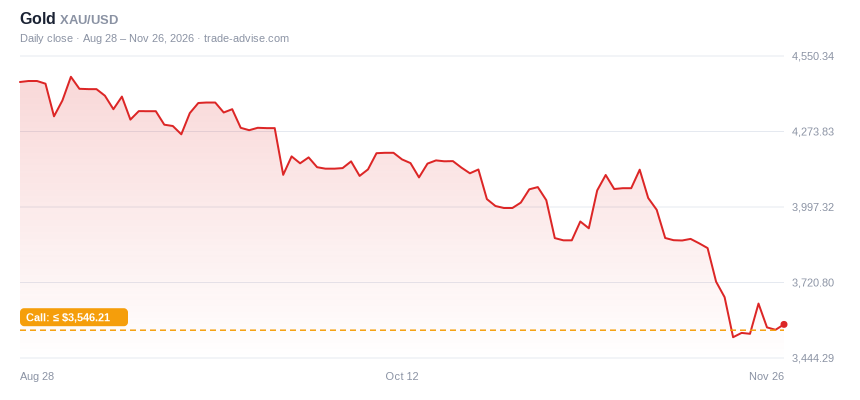
Now the number. XAU/USD is last at $3,571.01, up $23.47 (+0.66%). It opened almost exactly on the prior close of $3,547.53, ran as high as $3,606.46 and has since given back $35.45 of that push. With US desks closed for Thanksgiving, liquidity is thin, and I would not draw conclusions from a sub-1% move on a holiday. The broader context is harsher. Through Wednesday's close, gold had posted two consecutive red closes and a 30-session decline of 11.6%. It sits roughly 36% below its 52-week high of $5,595.46 and about $244 under its 20-session average of $3,814.99.
Gold is up 0.8% over five sessions, yet still 11.6% lower over thirty. This week's bounce has barely dented the slide.
Where I have been wrong, and why the rate channel keeps winning
My record on this metal deserves an honest accounting. I called a break below $3,850, and gold ran to $4,058.02 first. I then called a recovery above $4,070.17, and it sank to $3,883.59. The call that did land was the break of the $3,853.27 low, confirmed at $3,846.80. What changed between the misses was not the physical market. Real-rate expectations whipsawed in both directions faster than any haven bid could build. I have taken the lesson: tighter levels and shorter windows. Today's PCE print points that rate channel firmly against bullion again.
| Symbol | Close | Change | Day range | 52-week range |
|---|---|---|---|---|
| XAU/USD | $3,567.47 | +19.94 (+0.56%) | $3,546.21–$3,606.46 | $3,426.48–$5,595.46 |
I am not fully convinced the selling has further to run, and the counterargument deserves a fair hearing. A 14-session RSI of 30 sits at the classic oversold threshold. A metal more than a third off its high already carries a good deal of hawkishness in its price. Lower prices have historically drawn jewelers back into the market in India and China. Physical buyers in those two countries absorb tonnage that paper markets tend to forget about.
Here is what would change my mind. A Fed signal that it intends to hold in December, or a softer inflation read before the meeting, would cut the carry argument out from under my view. In that case the bounce would have room to retrace toward the 20-session average. On price, a daily close above Thursday's high of $3,606.46 would tell me the haven bid is finally beating the rate channel. Short of that, the thesis is most directly tested at Thursday's low of $3,546.21. A close beneath it within five sessions would confirm the holiday bounce as noise. It would also put the 52-week low of $3,426.48, set just this Wednesday, back in view.
The metal's old job was to protect against inflation. Its new problem is that inflation is exactly what is pushing the Fed to make holding it more expensive. Which of those two forces gets to set the price of an ounce when US desks return on Monday?