The argument doing the rounds this week, that the AI infrastructure build-out has reversed a more-than-decade-long trend in prices and threatens both the U.S. economy and an expensive stock market, is at heart a claim about physical metal: copper in busbars and transformer windings, silver in contacts and solar paste, electricity drawn from grids that were never built for server halls. Friday's metals rally looked like the market signing off on that story, and I'm not convinced it was. What I saw was a thin, holiday-shortened session covering a brutal month, with the commodities most exposed to data-center demand telling a less tidy story than the headline.

Start with the metal itself. Copper on the London Metal Exchange was reported on track for its first weekly gain since early October, on improved risk sentiment, having set a record above $15,000 a ton in September before a long slide. Silver's fall has been steeper still; one widely read analysis put the collapse from January's all-time high of $121.67 at almost 70% in under a year. If AI construction really were pulling metal out of warehouses fast enough to reprice the whole inflation outlook, I would expect it to show up first in the physical signals: exchange stocks drawing, nearby premiums widening, the curve tightening into backwardation as fabricators scramble for prompt tons. A week of relief after a rout is a different animal from a squeeze on deliverable metal.
| Symbol | Close | Change | Day range | 52-week range |
|---|---|---|---|---|
| XAU/USD | $3,654.58 | +0.18 (+0.00%) | $3,654.16–$3,655.37 | $3,426.48–$5,595.46 |
| DBA | $26.75 | +0.41 (+1.56%) | $26.45–$26.83 | $25.40–$29.52 |
| SOYB | $26.52 | +0.54 (+2.08%) | $26.17–$26.60 | $21.69–$28.19 |
| CORN | $17.47 | +0.25 (+1.45%) | $17.27–$17.58 | $16.37–$20.43 |
| WEAT | $21.49 | +0.19 (+0.89%) | $21.34–$21.76 | $19.78–$28.41 |
| CPER | $33.26 | +0.75 (+2.31%) | $33.04–$33.27 | $31.47–$41.52 |
| PALL | $16.15 | +0.45 (+2.87%) | $16.05–$16.33 | $14.91–$39.48 |
| PPLT | $11.97 | +0.41 (+3.55%) | $11.88–$12.02 | $11.03–$26.16 |
| SLV | $39.40 | +2.30 (+6.20%) | $38.92–$39.66 | $34.48–$109.83 |
| UNG | $9.8400 | -0.4600 (-4.47%) | $9.7700–$9.9100 | $8.9400–$17.0300 |
| BNO | $58.93 | -0.47 (-0.79%) | $58.81–$59.77 | $27.14–$72.50 |
| USO | $137.77 | -2.12 (-1.52%) | $137.33–$140.06 | $65.99–$171.82 |
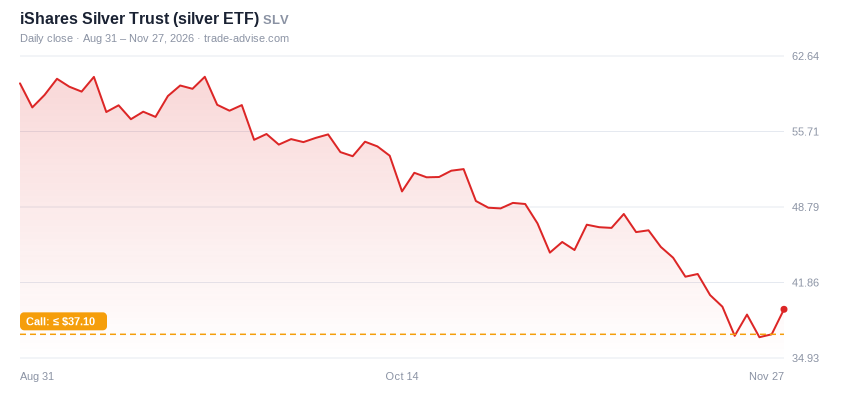
The screen, to be fair, was loud. The iShares Silver Trust (SLV) gapped up 6.66% at the open and closed +6.20% at $39.40, with the abrdn Physical Platinum Shares (PPLT) up 3.55% and the United States Copper Index Fund (CPER) up 2.31%. But look at the shape. SLV opened at $39.57, touched a $39.66 high and finished below its open, so the entire gain was made before the first trade and none was added afterward. Volume of 21.9 million shares ran at 0.9× its 20-session average, ordinary for a fund that has lost 24.1% over 30 sessions. A 6% day in a market that has shed nearly a quarter of its value in six weeks is a bounce with good press.
Copper is where the AI-inflation reading should be strongest, because no data center gets wired without it, and copper is where it is weakest. CPER closed at $33.26, almost on its high, yet its five-session change was still -1.5% while LME copper was reportedly heading for a weekly gain. Its 14-session RSI sits at 31, it trades 8.0% under its 20-session average of $36.15, and volume ran at 0.4× its 20-session norm. The London price and the U.S. fund's index are not measuring the same contract or the same window, but a demand shock strong enough to bend a decade-long price trend ought to be visible in both, and in volume, rather than in one headline and a quiet Friday.
Then there is power, the input the AI-inflation thesis leans on hardest, and it went the other way. The United States Natural Gas Fund (UNG) gapped down 5.05% and closed -4.47%. Crude did not cooperate with the bulls either, despite a supply story that would normally carry a session: Iraq's SOMO has delayed loadings of between 20 and 30 million barrels, according to Bloomberg, with no reason established. Those are Basrah barrels bound mostly East of Suez; on the Atlantic side, U.S. commercial crude inventories excluding the SPR rose 1.1 million barrels in the week to November 20. The United States Oil Fund (USO) fell 1.52% while the United States Brent Oil Fund (BNO) fell 0.79%, the WTI fund dropping nearly twice as hard as the Brent fund. The arb is telling you something about the Atlantic Basin: American barrels are building while Middle Eastern ones are going missing, and Brent holds its premium accordingly. That is a story about where the cargoes sit, and it has little to do with server racks.
Now the concession. One session cannot disprove a multi-year inflation argument, and the people making it may be right about the decade even if they are early about the week. Data-center construction is copper-intensive and power-hungry by design, and a build-out of that scale tightens markets over quarters, not over a half-day session after Thanksgiving. Whether a metals rally is cyclical relief or the first leg of a structural repricing is rarely settled on day two; it is settled when physical buyers keep paying up after the relief trade has run its course.
So here is where I would test it. The holiday-bounce reading is confirmed if SLV closes back below Thursday's $37.10 close within 10 sessions, filling Friday's gap; it is wrong if SLV instead closes above its 20-session average of $43.05 in that window. On copper, the same reading holds if CPER closes below its 90-day low of $32.50 within 10 sessions, and it falls apart if CPER reclaims its 20-session average of $36.15 first. What would change my mind faster than any price is evidence of physical tightness: warehouse draws, firmer nearby premiums, freight and delivery queues lengthening at the fabricators.
If the build-out really is rewriting the price trend of the last decade, why is the metal it needs most still trading as though the orders have not been placed?