Mumbai produced the week's most important foreign-exchange number on a day when the currency market barely moved. The Reserve Bank of India's half-yearly data show reserves rising $46.67 billion to $737.78 billion between April and September. The same filings show a central bank leaning harder on forward dollar sales to hold its line, which makes the buffer look larger on the balance sheet than it would be under pressure. Out in the G10, Thanksgiving-thinned trading kept every major pair inside a quarter of a percent, so the session's real content sits in the RBI's ledger rather than in the price screens of London or New York.

The Data Point
Start in Mumbai, where the headline is reassuring and the footnotes are less so. The RBI bought a net $6.94 billion in September, its fourth straight month on the buy side, according to The Hindu Business Line. Its outstanding forward dollar sales also climbed to nearly $240 billion. Those forwards are dollars already promised to the market at future dates. If you net them against the headline stock, the unencumbered pile comes to roughly $500 billion. That is still a formidable sum, but it is a different number from the one in the press release.
| Symbol | Close | Change | Day range | 52-week range |
|---|---|---|---|---|
| EUR/USD | $1.0972 | -0.0007 (-0.07%) | $1.0958–$1.0989 | $1.0882–$1.2066 |
| GBP/USD | $1.3109 | -0.0014 (-0.11%) | $1.3096–$1.3126 | $1.3012–$1.3862 |
| USD/JPY | $159.27 | +0.07 (+0.04%) | $158.96–$159.34 | $152.05–$164.09 |
| AUD/USD | $0.6634 | +0.0006 (+0.10%) | $0.6619–$0.6649 | $0.6465–$0.7280 |
| USD/CAD | $1.4247 | +0.0042 (+0.29%) | $1.4202–$1.4251 | $1.3482–$1.4385 |
| USD/CHF | $0.8342 | +0.0033 (+0.40%) | $0.8304–$0.8349 | $0.7607–$0.8444 |
| NZD/USD | $0.5471 | -0.0016 (-0.30%) | $0.5469–$0.5492 | $0.5434–$1.7163 |
| EUR/GBP | $0.8370 | +0.0003 (+0.03%) | $0.8362–$0.8380 | $0.8296–$0.8816 |
The external accounts complicate the picture further. Moneycontrol reported that India recorded an $8.1 billion decline on a balance-of-payments basis in April-June. That means the reserve gain appears to have come from somewhere other than a surplus in the country's dealings with the world. The likely sources are spot intervention and valuation, and valuation cuts both ways. The RBI held its gold steady at 880.52 tonnes, yet gold's share of reserves slipped to 14.38%, roughly $106 billion. The Hindu Business Line reported that the gold holding lost 8.75% of its value as prices dipped in September.
The connection runs back to Washington. Gold ticked lower again ahead of US inflation data, reportedly pressured by the Federal Reserve's hawkish posture. Every Fed-driven dip in bullion reduces India's buffer without a single tonne leaving the vault.
The Regional Ripple
Follow the reserves eastward and the story turns from India's balance sheet to the trade lanes that feed every Asian surplus. Beijing hit back at President Trump's latest tariff threat, and the trade war appears to be back on the agenda. For economies that build reserves out of export earnings, renewed tariff friction threatens the same inflow channel India is already struggling to fill.

Meanwhile in Australia, the September quarter's capital expenditure figures showed the biggest jump in years, driven by data centre construction and approaching mining-boom highs. The catch is that much of that spending goes on imported equipment. Imports widen the bill the current account has to fund, so the boom does little for the currency. AUD/USD edged up 0.09% to 0.6633, just 0.6% above its 90-day low of 0.6593. My earlier call that the Aussie would break 0.6715 was confirmed at 0.6712, and the pair has kept sinking since.
Across the Tasman, NZD/USD slipped 0.13% to 0.5480, down 3.6% over 30 sessions. I had expected the kiwi to recover above 0.5592. It never got close, because the dollar-funding drag I described lasted longer than the relief I anticipated.
The G10 Endpoint
From the Pacific to Zurich, the dollar gained against five of its seven counterparts, though none of the moves was large enough to read much into. USD/CHF was the biggest mover, up 0.23% to 0.8328. That partly reversed the previous session's flight into the franc and yen, as sliding Treasury yields tempered the haven bid.

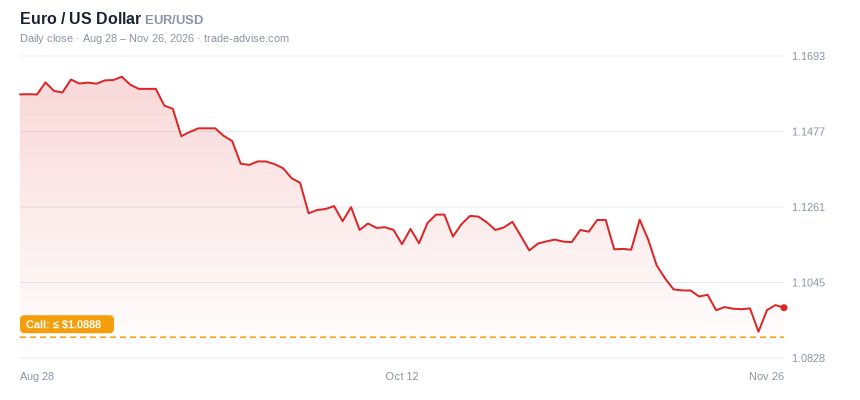
EUR/USD closed at 1.0973, its third straight green close. That run is a modest pause inside a 30-session decline of 1.5%, and the pair sits just 0.8% above its 90-day low of 1.0888.
The transmission from Mumbai to Frankfurt runs through reserve managers. When a central bank like the RBI absorbs dollars in the spot market while committing dollars forward, it holds dollar supply off the market today and pushes it into the future. That leaves less dollar liquidity in circulation for everyone else right now.
EUR/USD at 1.0888 is where this argument lives or dies. A close below that 90-day low within 10 sessions would confirm the dollar's bid is extending. A parallel break in AUD/USD below 0.6593 would show the commodity bloc paying the same price.
Three developments would change my mind:
- an AUD/USD close above the widely watched 0.6700 within that window;
- a soft US core inflation reading that pulls yields lower;
- a shrinking forward book in the RBI's next monthly bulletin.
The Pattern
The lesson of reading forward books before headlines was learned in Bangkok in 1997. The Bank of Thailand reported comfortable reserves while its forward commitments quietly consumed them. India today is far larger, far more liquid and in no comparable danger. Still, the habit of judging a reserve stock net of what has already been promised is the right one to bring to Mumbai's data.
Today's thin session linked a rupee defended forward, a yuan facing renewed tariff pressure, an Aussie dollar spending its capex boom on imports and a euro hovering above its lows. All of them point toward a dollar that the world's reserve managers are still accumulating. The last time the periphery's buffers proved smaller than they looked was 1997, and the center felt it roughly a year later, when Russia's default and the collapse of Long-Term Capital Management carried the stress into Treasuries and the yen.