Anthropic shares jumped in Friday's holiday-shortened session as the AI trade snapped back, with Dow futures up 650 points and Nvidia rebounding. The security story matters more than the rally itself. The model class lifting Anthropic is now generating an enterprise patch backlog, and that backlog lands on IT budgets as non-discretionary spend.

The link comes from the security side. Speaking to CNBC TV18, Arora tied recent technology outages to a surge in efforts to patch vulnerabilities exposed by Anthropic's Mythos model. That is a demand signal. When a model surfaces flaws at scale, every exposed system becomes a remediation ticket. Every rushed patch then carries outage risk of its own.
The implication: the attack surface is expanding faster than the budget. Security teams do not get to defer a known, published flaw. They fix it, and they pay for the fix out of someone else's line item.
The Spending Wave
Four categories get the emergency calls. Vulnerability and exposure management comes first, because teams need to know which assets Mythos-class discovery has put at risk. Patch orchestration and change control come second, because volume without sequencing is what produces outages.
Endpoint detection takes the third slot. The window between disclosure and fix is where exploitation happens, and detection covers that gap. Resilience and observability tooling rounds out the list, since a patch that takes down production is its own incident.
The money gets pulled forward from discretionary projects. Net-new application builds and exploratory AI pilots lose budget first. The macro backdrop sharpens that squeeze. The Financial Times reports a hawkish Fed poised to raise rates despite the tech-led sell-off. Tighter money cuts optional software seats. It does not cut the remediation queue.
The Winners
The consensus beneficiary is Anthropic itself, and Friday's jump already prices that in. A model that finds flaws earns attention. The less obvious winners are the vendors who own the path from discovered flaw to deployed fix.

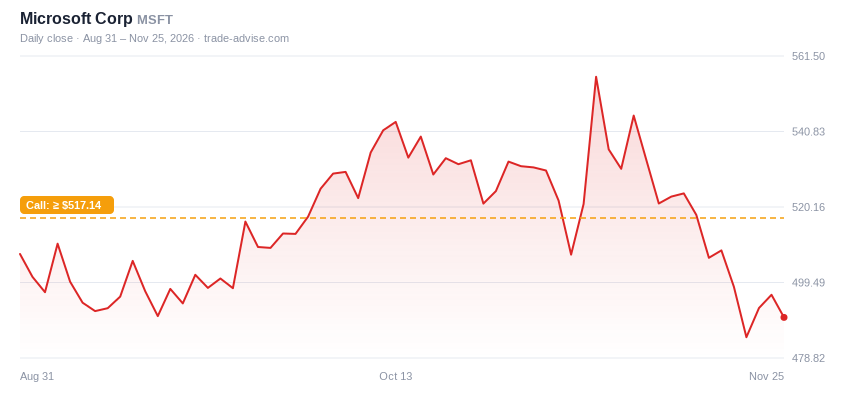
Microsoft (MSFT) sits at the center of that path. It ships the patches for the largest enterprise desktop and server estate and sells the detection layer on top through Defender and Sentinel. One vendor delivering both the fix and the monitoring is the consolidation pitch CISOs already favor. Yet the shares fell 1.25% to $489.93 in Wednesday's session after touching $477.39, a 20-session low. The close sits 5.3% below the 20-session average of $517.14. The market is pricing AI capex fear and ignoring security pull-through.
Alphabet (GOOGL) is the second name. Google Cloud's security operations stack and Mandiant's incident-response bench sell directly into a disclosure-driven cycle. Shares fell 2.13% to $273.10 on Wednesday and trade at 14.2x trailing earnings, against a 23.1x median for the ten large caps tracked. A remediation wave lifts consulting hours and platform seats together.
Amazon (AMZN) collects the third share through AWS native security services. Workloads already in AWS default to its tooling when patch velocity spikes. Shares lost 3.12% to $244.43 on Wednesday, so the market is not crediting that either.
Microsoft is where this view gets tested most directly. A close above $517.14 within 20 days would show investors paying for the platform's security pull-through. A close below $477.39 in that window would say the AI capex discount still outweighs it. Fading reports of patch-driven outages would also weaken the case.
The Wallet-Share Call
Mythos-class discovery does not stop at one model or one disclosure cycle. Each new model release widens the pool of findable flaws, and each finding lands in the remediation queue. That keeps the spend recurring. The winners are vendors that close the loop from discovery to deployment inside one contract, because consolidation is the trend and the platform play wins.

Exposure management and patch orchestration take share from discretionary AI pilot budgets. Microsoft and Alphabet benefit most.